
The 2026 AI Revolution: Top 5 Smartphones That Think Like Humans!
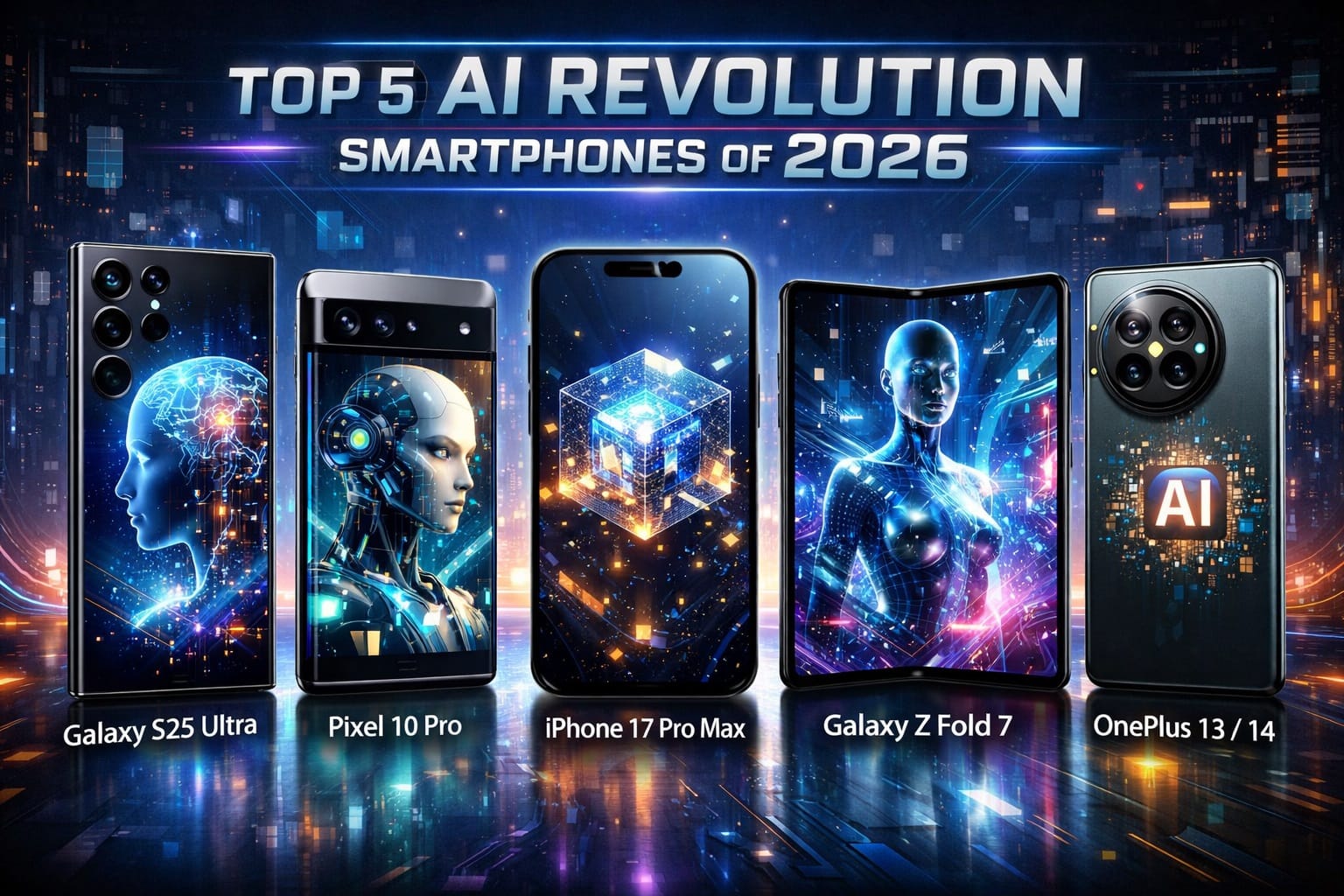
In 2026, smartphones have evolved from mere tools into Personal AI Agents. Using advanced NPU (Neural Processing Unit) chips and Generative AI, these devices don’t just follow commands—they predict your needs, translate your world in real-time, and edit your life with human-like intuition.
The smartphones of 2026 are defined by On-Device AI. Unlike previous years where AI lived in the cloud, these five flagships process complex logic locally, ensuring speed and privacy. Whether it’s Samsung’s multi-modal intelligence or Apple’s private cloud compute, these phones now possess “cognitive-like” capabilities to manage your schedule, photos, and communication.
Comparison Table (2026 Flagships)
|
Feature |
Galaxy S25 Ultra |
Pixel 10 Pro |
iPhone 17 Pro Max |
Galaxy Z Fold 7 |
OnePlus 13/14 |
|
AI Engine |
Galaxy AI 3.0 |
Google Tensor G5 |
Apple Intelligence 2.0 |
Galaxy AI (Fold Edition) |
OxygenOS AI |
|
Processor |
Snapdragon 8 Gen 4 |
Tensor G5 (TSMC Built) |
A19 Pro |
Snapdragon 8 Gen 4 |
Snapdragon 8 Gen 4 |
|
Thinking Style |
Predictive & Logic |
Human-centric/Creative |
Intuitive & Private |
Productivity & Context |
Speed & Automation |
|
Core AI Skill |
Real-time Live Translate |
Gemini DeepMind Hub |
Siri Intent Engine |
Large Screen Multitasking |
Adaptive Performance |
|
RAM |
16GB – 20GB |
16GB |
12GB – 16GB |
16GB |
24GB |
In-Depth Analysis: How They “Think”
1. Samsung Galaxy S25 Ultra: The AI Master
The S25 Ultra uses Galaxy AI 3.0 to act as a proactive assistant. It anticipates user needs and suggests actions. Its 200MP camera uses AI to improve low-light details.
2. Google Pixel 10 Pro: The Pure AI Experience
With the Tensor G5 (TSMC), the Pixel 10 Pro excels in conversation. Its Gemini Live integration enables conversations. It generates high-end video from text prompts.
3. iPhone 17 Pro Max: Apple Intelligence 2.0
Apple focuses on Contextual Intelligence. The iPhone 17 Pro Max understands a user’s social connections and on-screen content to provide assistance.
4. Samsung Galaxy Z Fold 7: The AI Productivity King
The Fold 7 provides Spatial Intelligence. It can summarize meetings and create presentations simultaneously.
5. OnePlus 13 / 14: The Speed AI
OnePlus uses AI for Invisible Optimization. It pre-loads apps based on user behavior.
Pros & Cons
- Samsung S25 Ultra: ✅ Most features; ❌ AI can feel overwhelming/cluttered.
- Pixel 10 Pro: ✅ Most natural voice interaction; ❌ Historically weaker hardware than Samsung.
- iPhone 17 Pro Max: ✅ Best privacy; ❌ AI rollout can be slow in some regions.
- Galaxy Z Fold 7: ✅ Best for work; ❌ Extremely expensive.
- OnePlus 13/14: ✅ Fastest performance; ❌ Fewer “creative” AI features than Google/Samsung.
Frequently Asked Questions (FAQs)
- Q: Does AI make the battery die faster?
- In 2026, the Snapdragon 8 Gen 4 and A19 Pro have dedicated AI cores that use less power for AI tasks.
- Q: Is my data safe with “Thinking” phones?
- Most 2026 flagships use On-Device Processing, so user data stays on the phone.
- Q: Do I have to pay for these AI features?
- Samsung and Google have moved toward a “Freemium” model where basic AI is free, but “Ultra AI” features may require a subscription.
Our Verdict
- The Smartest All-Rounder: The SAMSUNG Galaxy S25 Ultra is the most complete AI phone.
- The Best for Conversation: Google Pixel 10 Pro is the choice for an AI friend/creative partner.
- The Best for Privacy: The iPhone 17 Pro Max is the winner for users who want intelligence without data risk.
The “Smart Buyer” Advice
In 2026, choosing the right tech isn’t just about the highest specs; it’s about how well the device fits into your daily lifestyle. Before you hit the ‘Buy Now’ button, ask yourself: Does this device support the ecosystem I already use? Whether it’s the AI integration in your smartphone or the seamless pairing of your earbuds, the best value for your money comes from devices that work together to save you time. Always prioritize battery life and long-term software support over flashy new features that you might never use.

Leave a Reply