
Garmin Vívoactive 5 vs. Amazfit Active Max: The Ultimate Smartwatch Showdown
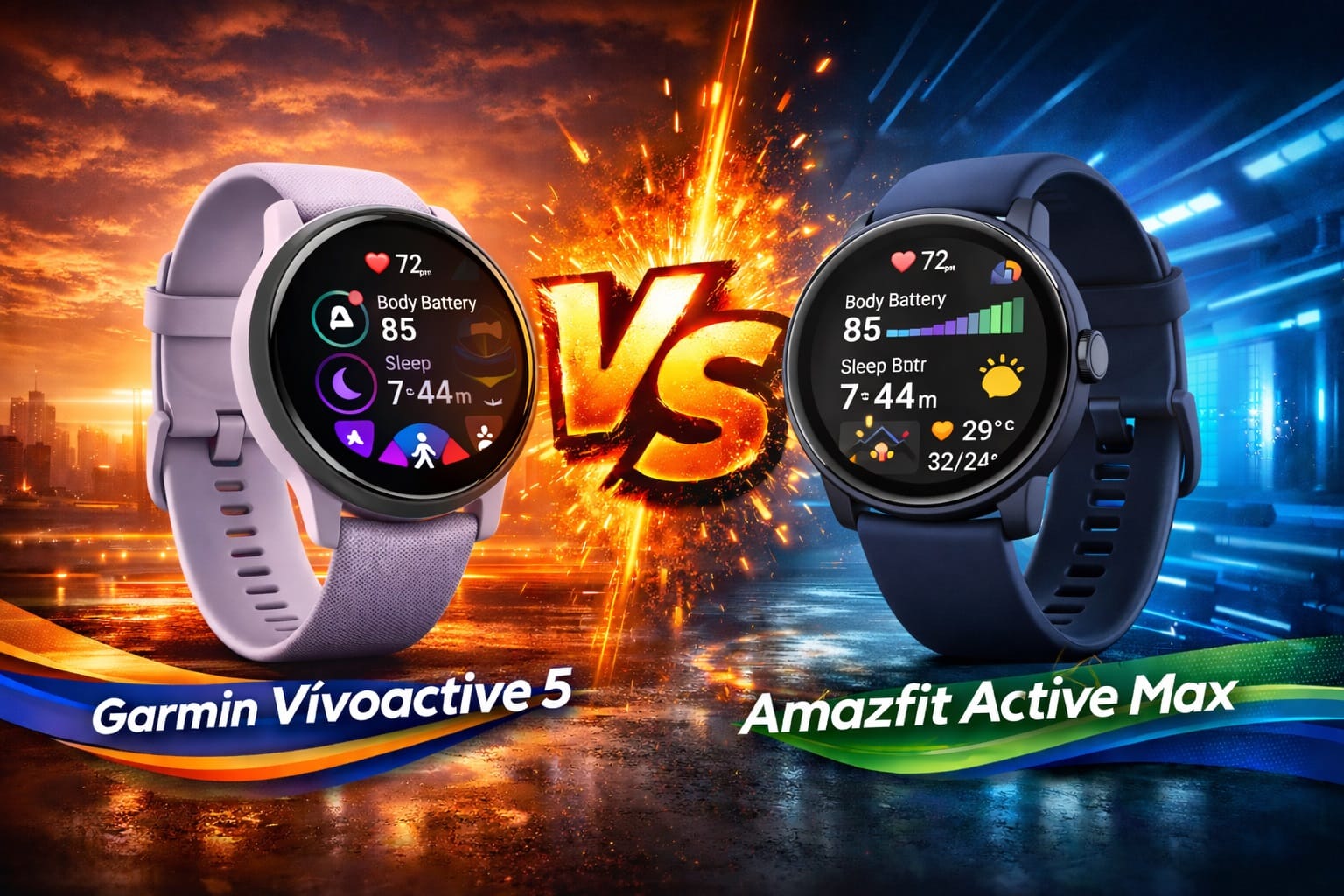
Garmin Vívoactive 5 vs. Amazfit Active Max – Battery Life or Training Analytics?
The Garmin Vívoactive 5 is the superior choice for serious athletes who prioritize data precision and deep physiological insights. Conversely, the Amazfit Active Max excels as a lifestyle-first smartwatch, offering a significantly larger display, longer battery life, and modern smart features like Bluetooth calling at a more budget-friendly price point.
Garmin and Amazfit represent two different philosophies in the wearable market. Garmin’s Vívoactive 5 focuses on a refined ecosystem where heart rate accuracy and training recovery data are paramount. The Amazfit Active Max, launched in early 2026, is designed for users who want “more of everything”—a bigger screen, a bigger battery, and more built-in smart tools—without the premium price tag.
Detailed Comparison Table
|
Feature |
Garmin Vívoactive 5 |
Amazfit Active Max |
|
Display |
1.2″ AMOLED (390 x 390) |
1.5″ AMOLED (480 x 480) |
|
Peak Brightness |
~1000 nits (Estimated) |
3000 nits |
|
Battery Life |
Up to 11 days (Smartwatch) |
Up to 25 days (Typical) |
|
GPS Tracking |
Up to 21 hours |
Up to 64 hours |
|
Smart Features |
NFC Payments, Music Storage |
Bluetooth Calling, Speaker/Mic, AI Voice |
|
Training Insights |
Body Battery, Sleep Coach, HRV |
BioCharge, Zepp AI Coach |
|
Accuracy |
High (Market-leading algorithms) |
Moderate (Occasional step/GPS errors) |
|
Water Resistance |
5 ATM |
5 ATM |
Pros & Cons
Garmin Vívoactive 5
- Pros:
- Scientific Accuracy: Reviewers from the5krunner and RunToTheFinish consistently rate Garmin’s heart rate and GPS data as more reliable for intense training.
- Ecosystem Depth: Features like Body Battery and recovery time interpretations are considered more mature and actionable than Amazfit’s alternatives.
- Durability: Uses Corning Gorilla Glass 3 for better scratch resistance compared to standard strengthened glass.
- Cons:
- Limited Smartness: Lacks a microphone and speaker, so it cannot be used for phone calls on the wrist.
- Smaller Display: The 1.2-inch screen is noticeably smaller and less bright than the Active Max.
Amazfit Active Max
- Pros:
- Stunning Display: The 1.5-inch 3000-nit AMOLED is one of the brightest and clearest screens in its class.
- Massive Battery: Can last nearly a month on a single charge under light use, outlasting almost all mainstream rivals.
- Built-in Calling: Allows you to take and make Bluetooth phone calls directly from the watch.
- Cons:
- Data Inconsistency: Users on Reddit and testers at Tom’s Guide have noted that it may overcount steps or miscalculate elevation during long hikes.
- Bulkier Design: With a larger 48.5mm case, it may feel too big for users with smaller wrists compared to the more compact 42.2mm Garmin.
Frequently Asked Questions (FAQs)
- Can I reply to messages on these watches?
Both support notifications. However, the Amazfit Active Max includes an on-screen QWERTY keyboard and AI voice replies (on Android) for more detailed interaction. - Which watch is better for swimming?
Both are rated 5 ATM (50m water resistance). While both track laps, Garmin is often preferred for more precise heart rate tracking while submerged. - Does the Amazfit Active Max support contactless payments?
Yes, it supports Zepp Pay in many regions (including EMEA), similar to Garmin’s Garmin Pay.
Our Verdict
Choose the Garmin Vívoactive 5 if you are training for a specific goal (like a marathon) and need highly accurate data to track your progress. Choose the Amazfit Active Max if you want the best hardware value—a huge, beautiful screen and incredible battery life—along with convenient features like wrist-based calling at roughly half the price.
Price & Availability
Top Recommended
GearTechScope is a participant in the Amazon Services LLC Associates Program, an affiliate advertising program designed to provide a means for sites to earn advertising fees by advertising and linking to Amazon.com.
Leave a Reply