
JBL Tune 720BT vs Sony WH‑CH520 – The Real Value Clash
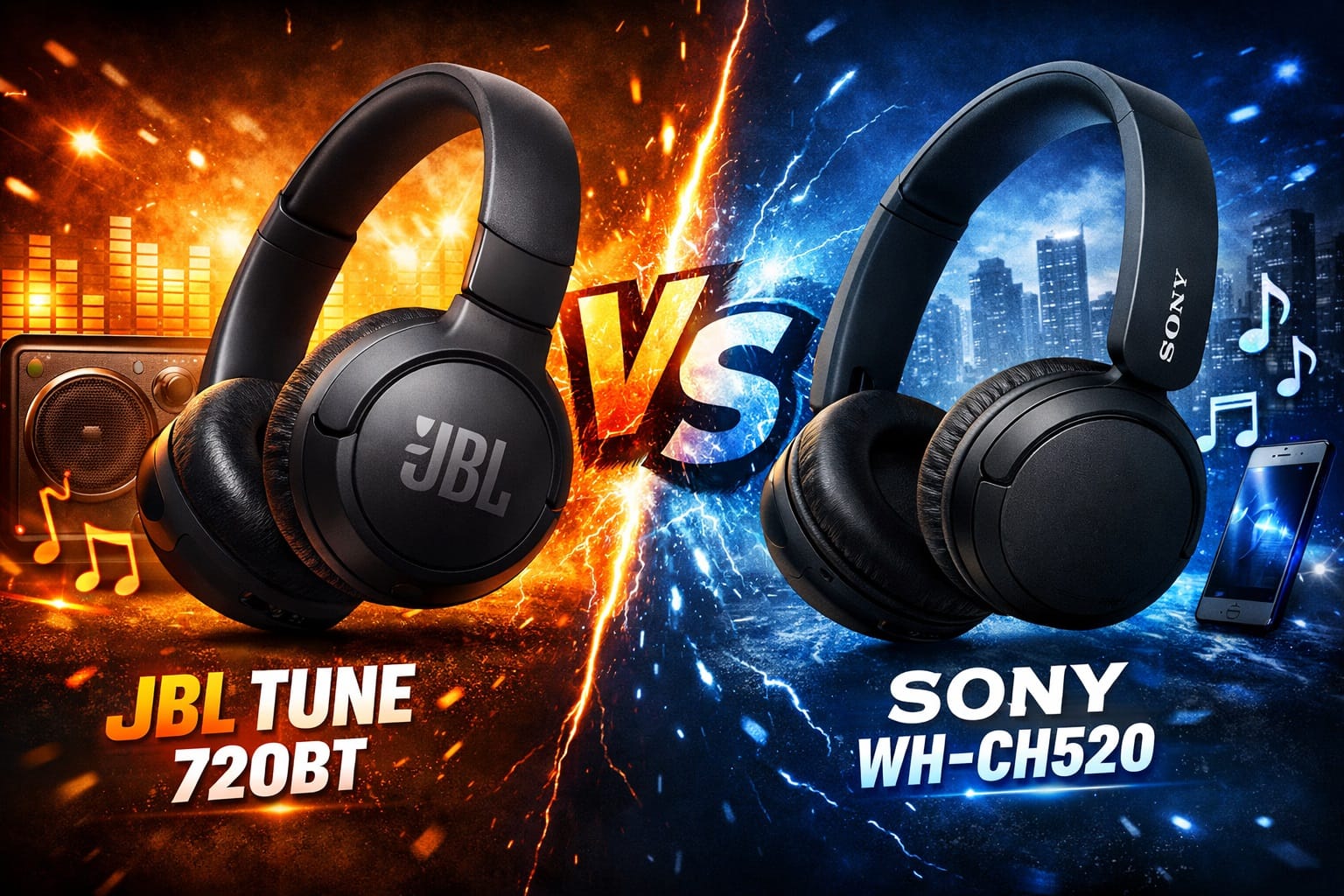
JBL Tune 720BT vs Sony WH‑CH520 – Two Budget Kings, One Choice
In 2026, the budget headphone market is dominated by two philosophies: Power & Bass vs. Portability & Intelligence. The JBL Tune 720BT is a powerhouse built for long-lasting, deep-bass sessions, while the Sony WH-CH520 focuses on being the lightest, smartest daily driver for commuters.
The JBL Tune 720BT is an Over-Ear headphone, meaning it cups around your ears for better isolation and a massive “thump.” It is the king of battery life in this segment. The Sony WH-CH520 is an On-Ear headphone, sitting directly on your ears. It is much smaller, lighter, and features Sony’s advanced software that makes low-quality YouTube or Spotify tracks sound significantly better.
Specifications (2026 Comparison)
|
Feature |
JBL Tune 720BT |
Sony WH-CH520 |
|
Design |
Over-Ear (Circumaural) |
On-Ear (Supra-aural) |
|
Battery Life |
Up to 76 Hours |
Up to 50 Hours |
|
Charging |
5 mins = 3 Hours |
3 mins = 1.5 Hours |
|
Weight |
220g |
147g (Ultra-Light) |
|
Bluetooth |
5.3 (Multipoint) |
5.2 (Multipoint) |
|
Sound Tech |
JBL Pure Bass Sound |
DSEE (Digital Sound Engine) |
|
Customization |
JBL Headphones App |
Sony Headphones Connect |
|
Wired Option |
Yes (3.5mm Jack) |
No (Wireless Only) |
In-Depth Analysis
1. Sound Quality: Bass vs. Detail
- JBL Tune 720BT: If you listen to Hip-Hop, EDM, Pop, the 40mm drivers in the JBL provide a massive, vibrating bass that Sony cannot match. It also supports a wired connection, which is better for lag-free gaming or movies.
- Sony WH-CH520: Focuses on clarity. Its DSEE (Digital Sound Enhancement Engine) technology restores high-frequency elements lost in compression. This makes vocals and acoustic instruments sound more crisp and “high-end.”
2. Comfort & Portability
- Sony: At only 147g, the CH520 is so light you can wear it all day without neck strain. It’s perfect for office workers or students who need something discrete.
- JBL: Being an over-ear design, it provides better passive noise isolation. It blocks out more office chatter or engine noise simply by covering your ears, but it is bulkier to carry in a backpack.
3. Battery & Utility
JBL is the clear winner here with a massive 76-hour battery life, almost 25% more than Sony. Furthermore, JBL includes a 3.5mm jack, allowing you to use them even if the battery dies—a feature Sony completely removed from the CH520.
Pros & Cons
JBL Tune 720BT
- Pros: Massive 76-hour battery; Deep Pure Bass; Over-ear comfort; Wired 3.5mm support.
- Cons: Bulky design; Microphones are average in windy conditions; All-plastic build can feel “creaky.”
Sony WH-CH520
- Pros: Extremely lightweight (147g); DSEE sound upscaling; Best-in-class Sony App customization; Multipoint works flawlessly.
- Cons: No wired mode; On-ear design can cause “ear pressure” after 3+ hours; No passive noise isolation.
Frequently Asked Questions (FAQs)
- Q: Can I use the Sony WH-CH520 for gaming?
- Only via Bluetooth. Because it has no 3.5mm jack, you might experience a slight delay (latency) in fast-paced games.
- Q: Does the JBL Tune 720BT have Noise Cancellation (ANC)?
- No. It has Passive Isolation (physical blocking), but it does not have electronic Active Noise Cancellation.
- Q: Which one is better for gym workouts?
- The Sony WH-CH520 is better because it is lighter and stays cooler on your ears, though neither is officially “sweat-proof.”
Our Verdict
- Choose the JBL Tune 720BT if you are a Bass Lover or Traveler. If you want a headphone you only charge once a month, love heavy bass, and want the security of a wired backup, JBL is the king of 2026 budget audio.
- Choose the Sony WH-CH520 if you are a Commuter or Student. If you prioritize a lightweight design for long study sessions, want the best app-controlled sound, and don’t care about a wired connection, the Sony is the ultimate portable choice.

Leave a Reply